
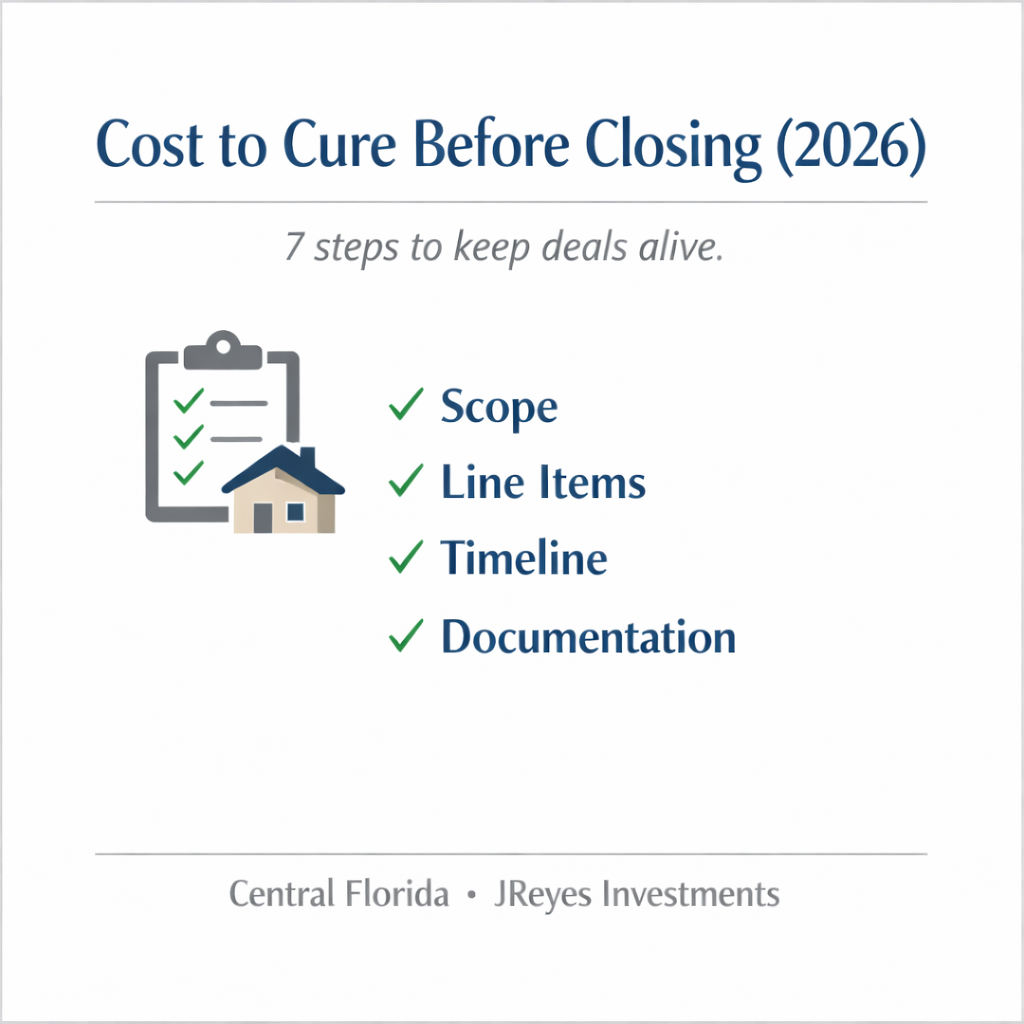
This guide shows you how to use cost to cure repairs before closing to remove uncertainty, negotiate faster, and protect the closing date.
If you’re trying to close a residential deal in Florida in 2026, here’s the truth: buyers are more rate-sensitive, inventory is less tight than before, and nobody wants surprise repairs. That’s why cost to cure repairs before closing has become the difference between a smooth closing and a deal that stalls, gets re-traded, or dies.
Most people handle inspection repair negotiations the wrong way: emotionally, with random numbers, and no timeline. The right way is simple: convert uncertainty into a clear plan.
This post breaks down a practical 7-step approach that works for buyers, sellers, and agents in Central Florida.
Why inspection repairs are deciding closings in 2026
When the market isn’t “anything sells instantly,” buyers negotiate harder and lenders/insurers scrutinize condition more. The biggest deal-killers tend to be:
- unclear repair scope (“what exactly is being fixed?”)
- unknown costs (“is this $800 or $8,000?”)
- no timeline (“can this be done before closing?”)
- roof/4-point friction (insurance approval delays)
- vendor chaos (too many contractors, no coordination)
If you remove uncertainty fast, you protect the transaction.
Step 1: Identify the deal blockers (not every minor item)
A winning repair strategy starts by sorting the inspection list into two buckets:
Deal blockers (must solve):
- items tied to safety, water intrusion, structural concerns
- roof/exterior issues that trigger underwriting
- anything that can delay appraisal/insurance approval
Negotiation noise (optional):
- cosmetic items
- small defects that don’t affect closing timelines
Deals don’t die from a loose doorknob. They die from uncertainty around major risk items.
Step 2: Turn the inspection list into a clean scope
This is where most agents lose time. A scope means:
- what work will be done
- what materials/standards will be used
- what is excluded (so nobody assumes extras)
- what “complete” looks like
A clean scope prevents scope creep and prevents last-minute disputes.
Step 3: Produce line-item pricing (not one big number)
“$5,000” with no detail creates mistrust.
Line-item pricing creates clarity and negotiation power.
The buyer can accept, reject, or adjust specific items instead of fighting the whole deal.
Step 4: Add a timeline that matches the closing date
A repair plan without a timeline is useless.
You need:
- estimated start date
- time to completion
- dependencies (permits/material lead times)
- what can realistically be completed before closing
This is where cost to cure repairs before closing becomes a real tool instead of a theory.
Step 5: Decide repair vs credit based on underwriting reality
Credits feel easy, but they can fail when:
- insurance approval requires completion
- the buyer’s lender wants repairs done
- the closing date is tight
Repairs are often the better path when you need underwriting to stop stalling and the buyer wants certainty.
Credits can work when:
- the item is non-urgent/cosmetic
- the buyer has flexibility after closing
- there’s no underwriting dependency
Your job is not to “win the argument.” Your job is to protect closing.
Step 6: Document like a professional (photos + receipts)
Documentation reduces fear.
Fear kills deals.
At minimum, keep:
- before/after photos
- invoices/receipts
- a simple completion note (what was done + when)
This matters most on roof/exterior work and any repair tied to water intrusion.
Step 7: Execute with one system (less vendor chaos)
Here’s the part most people learn the hard way: even a perfect scope can fail if execution is disorganized.
One point of contact, coordinated scheduling, and clean communication are what keep repairs from turning into delays.
For coordinated GC execution and close-ready repairs under one system, use TOLT Construction (Licensed GC): https://toltcgc.com/
If the deal is being delayed by roof/4-point friction, scope, or roof documentation, use Roof Roof: https://roofccc.com/
Where JReyes Investments fits
JReyes Investments is built around “inspection-to-close” reality: clarity + disciplined execution.
When a deal is at risk, we help you create a clean plan fast:
- a clear scope (what’s being fixed)
- line-item pricing (so you can negotiate)
- a timeline (so you can protect closing)
That’s what cost to cure repairs before closing is supposed to do: reduce uncertainty and keep the transaction moving.
If you have an inspection report that’s turning into a negotiation mess, reach out and ask for a Deal Rescue Assessment. We’ll help you convert the list into a practical plan you can use to negotiate and close.
If you’re under deadline, cost to cure repairs before closing is the fastest way to turn an inspection list into a clear scope, price, and timeline.