
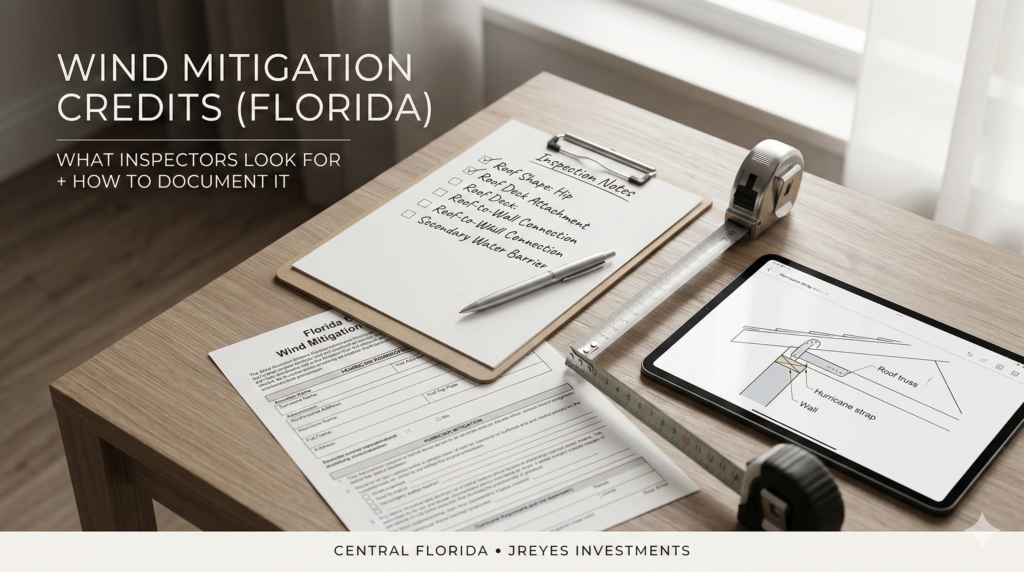
If you own a home in Central Florida, wind mitigation credits Florida can be one of the most meaningful ways to reduce insurance costs—but only when the documentation is correct. Many homeowners assume “I have shutters” or “my roof is newer” automatically equals credits. That’s not how the OIR form works.
Wind mitigation is a documentation game: what features exist, how they’re verified, and whether the inspector can prove them clearly enough for the insurer to accept the credits.
This guide explains what inspectors typically look for on the OIR wind mitigation form and how to prepare so you don’t lose credits due to missing proof.
Wind mitigation credits Florida: why people lose credits even when they “have the upgrades”
Most credits don’t get denied because the home lacks the feature. Credits get lost because:
- documentation is missing (no proof of opening protection, roof covering, or attachments)
- the upgrade exists but can’t be verified
- the wrong assumption is made about what qualifies
- photos don’t show the critical details insurers need
If you want wind mitigation credits Florida to actually show up on your premium, you need the proof.
What inspectors commonly verify on the OIR form (in plain language)
The OIR form generally documents real, measurable wind-resistance features. In practical terms, inspectors look for:
1) Roof covering and roof permit history (when available)
Newer roof coverings may help, but the important part is being able to verify age/type and installation history.
2) Roof-to-wall attachment
This is where many credits are won or lost. Inspectors may look for evidence of straps, clips, toe nails, or other attachment methods—and the proof is usually photographic from the attic.
3) Roof deck attachment
Inspectors often verify how the roof deck is attached (fasteners and spacing). Again, proof matters.
4) Secondary water resistance (SWR)
If SWR exists, it may qualify for credit—if it can be verified.
5) Opening protection
Shutters and impact-rated openings can matter, but the insurer needs proof that they qualify (not all shutters are equal).
Bottom line: wind mitigation credits Florida are earned by verifiable features, not by assumptions.
The documentation checklist that makes credits easy to approve
If you want to maximize acceptance of wind mitigation credits Florida, prepare these before the inspection (when possible):
- Roof invoices/receipts and permit records (if you have them)
- Product approvals or documentation for shutters/impact windows (if applicable)
- Any prior wind mitigation report (for comparison and continuity)
- Access to the attic (this is where key proof is found)
- Clear photos of labels/ratings when they exist (openings/garage door)
This doesn’t mean you must have everything. It means you show up organized, and the inspector can document the home properly.
Realtor angle: why this matters before listing or during escrow
For listings and closings, insurance friction kills momentum. If a buyer can’t get premiums to a reasonable level—or can’t bind coverage in time—deals stall.
A clean wind mitigation package can:
- reduce buyer uncertainty
- support insurance shopping quickly
- strengthen negotiations (less re-trading on “insurance surprise”)
If you’re dealing with wind mitigation credits Florida during escrow, speed and documentation matter more than opinions.
Where JReyes Investments fits (inspection-to-close execution)
We help homeowners and agents reduce deal friction by building clarity fast. When insurance documentation or repair scope is slowing things down, we turn chaos into a plan.
For construction coordination and close-ready repairs under a licensed GC system, use TOLT Construction: https://toltcgc.com/
For roof-related scope and documentation that often ties into mitigation conversations, use Roof Roof: https://roofccc.com/
To keep this post “internal-link clean” for your SEO tool, add this link on your site:
Learn more about our Deal Rescue Assessment here: https://jreyesinvestments.com/deal-rescue-assessment/
(If that page doesn’t exist yet, use your contact page: https://jreyesinvestments.com/contact/)
Next step
If you want a simple checklist to prepare for a wind mitigation inspection (or you’re under deadline during escrow), message us WIND and tell us your county (Orange / Seminole / Lake). We’ll send a quick documentation checklist so you don’t lose wind mitigation credits Florida due to missing proof.